Announcements
Open Letter to the University of Bonn
Securing and maintaining the Bonn Online Bibliography for Comics Research (BOBC)
To the Dean of Philosophy and the Chancellor at Bonn University,
The Bonn Online Bibliography for Comics Studies (BOBC, https://www.bobc.uni-bonn.de) was launched in 2008 under the direction of Dr. Joachim Trinkwitz, research assistant at the Institute for German Studies, Comparative Literature and Cultural Studies at the Rheinische FriedrichWilhelms-Universität Bonn. Initially designed as a tool for teaching, it was later published online as a service for the research community. Since then, it has been continuously expanded under Trinkiwtz’ direction. Thanks to his tireless effort, it now offers more than 13,500 international entries for researcher in interdisciplinary comics studies. Particularly noteworthy is the rich indexing of all entries (the dynamically expanded keyword catalogue now includes almost 4,800 entries, each in English and German), made possible by Dr. Trinkwitz’ decades of expertise and interdisciplinary knowledge.
The BOBC has become an irreplaceable, unique resource for international comics studies: it is a central point of reference for this growing field. It is acknowledged well beyond the German-speaking world by renowned researchers as well as international institutions of comics research, who regularly use it and recommend it to young academics (see also the attached research report by Prof. Dr. Bart Beaty and Prof. Dr. Benjamin Woo from the Universities of Calgary and Carleton, Canada). Every month, up to 150,000 database queries and hundreds of individual page views are counted by visitors from all over the world (18% of whom come from the USA and Canada). The bibliography has become an indispensable tool not only in German studies, but also in art and media studies, cultural studies and multimodal linguistics, as well as for many other philologies – such as American studies, English studies, Romance studies, Scandinavian studies, and Japanese studies – which we can no longer conceive their teaching and research into comics without this tool. Recently, even representatives of seemingly more remote disciplines such as medicine, religious studies/theology, and geography have become users of the bibliography.
The German Society for Comics Studies (ComFor e.V.) has been supporting the BOBC for almost a decade with regular sums from its membership fees to finance student staff positions for the initial recording of the ever more rapidly growing number of relevant new publications in our research fields. In order to maintain this indispensable resource, however, beyond this continuous technical labour, there is the need for constant indexing, coherence checking, and qualitative data control, for which an experienced colleague such as Dr Trinkwitz is needed.
In order to secure the future of this important resource even after the imminent retirement of our esteemed colleague, we therefore turn to the University of Bonn and its Faculty of Philosophy with two urgent questions in particular:
- 1) How can the technical infrastructure for the BOBC be secured?
The BOBC is currently running on a server of the Bonn Institute under the open source database software “WIKINDX”, which is currently maintained steadily and with commitment, but only through the efforts of a few individuals worldwide. Sooner or later, therefore, it will be necessary either to make a switch to a more expensive alternative database system that is professionally maintained, or to set up a (half-time) IT and information technology position that can continue to update and maintain WIKINDX. - 2) How can the professional maintenance of the BOBC be secured?
Quality control, maintenance, and indexing of new entries require the continued work of a fully employed academic at no less than postgraduate level. Additional support by auxiliary staff for data entry can still be ensured through partner institutions such as the German Society for Comics Studies. We would therefore like to invite you to enter into a dialogue with the German Society for Comics Studies to discuss these needs in order to ensure the continued availability of this internationally and interdisciplinarily renowned research resource at the University of Bonn.
Signatories:
Dr. Joachim Trinkwitz for the BOBC
PD Dr. Christina Meyer, Dr. Lukas R.A. Wilde and Dr. Vanessa Ossa
for the Society for Comics Research (ComFor)
Working Group BOBC within ComFor:
Nicolas Gaspers (Düsseldorf),
PD Dr. Christina Meyer (Braunschweig),
Prof. Dr. Stephan Packard (Köln),
Dr. Joachim Trinkwitz (Bonn),
Dr. Lukas R.A. Wilde (Tübingen)
Continue Reading about supporting Institutions, colleagues, and research report
Comics|Histories – International Conference
The international Conference “Comics|Histories” is organised by ComFor members Jaqueline Berndt (Stockholm University, Sweden), Felix Giesa (Goethe University
Frankfurt, Germany) and Christina Meyer (TU Braunschweig, Germany).
Description of the conference by the organisers:
“Comics Studies are on the rise, but the bulk of comics research prioritizes contemporary productions, whereas comics’ histories and genealogies, or preconditions of what appears as comics and the forms of graphic narratives today, remain understudied. To fill the gap and to map as yet unknown territories, a new book series will be launched soon by academic publisher Rombach Wissenschaft, and this conference, organized by the series editors, is intended as a kick-off event. The book series and conference aim to revise the wide spectrum of what is now regarded as comics (including caricature, cartoons, graphic novel, etc.), broadening the view of Comics Studies not only retrospectively, but also prospectively at a moment in time when modern media identities are dissolving.
We welcome in particular contributions that engage with both theories and methods employed in Comics Studies so far, and crucial disciplinary concerns of history (as specified in literary, cultural, media, or art history, and so on). While there is already a significant amount of publications that foreground representations history in comics, our conference seeks to highlight comics-specific contributions to history. In addition to that, we invite papers that address comics from a transnational while culturally situated, perspective, without privileging national histories of the medium in the narrower sense, i.e., as confined to North American, Franco-Belgian, or Japanese publication markets. Last but not least, we call for papers that put the spotlight on the historiography of Comics Studies, in other words, the inter- and transdisciplinary research on comics as an object of analysis in itself. Multidisciplinary assessments of the field and its practices of research and publishing, authorand editorship promise new insight into processes of knowledge formation, as well as the power relations involved.”
Registration is open until July 15th via comicshistories@uni-frankfurt.de.
The conference takes place online via ZOOM from July 16th to July 17th; the ZOOM link will be sent out to registered participants.
MA Comics Studies at the University of East Anglia
 Good news in the academic field of comics studies: the University of East Anglia introduces an MA in Comics Studies – the first one of its kind worldwide, they say -, starting this fall; applications are open now and should not be submitted later than 31st of July 2020. Tuition fees for the academic year 2020/2021 are: £7,850 for full time UK/EU Students and £16,400 for full time international students.
Overview:
“The MA in Comics Studies is the only MA programme of its kind in the world, and whether you are new to the field of comics studies or are developing existing interests, the programme will serve to deepen and broaden your understanding of comics and their associated cultures.
As a student on the programme, you will learn about comics from a range of international contexts such as Great Britain, the United States, Europe, Japan and others. You will also learn about the various theoretical approaches to studying comics, including the unique ways comics make meaning from the combination of words and images.
World-leading comics scholars will guide you through the complex histories, cultures and politics of the form. You will take a year-long, team-taught module focusing on key issues in comics studies, with additional compulsory modules in the theory and practice of comics studies and the long-standing relationship between film and comics. You will also choose from a wide variety of optional modules that touch upon such issues as politics, gender, sexuality and race in both comics and related media.
Through these modules, you will develop your ability to undertake advanced independent research projects. In addition, you will deepen your critical and analytical skills, especially in relation to understanding and evaluating visual art and storytelling.”
Another helpful resource on comics studies might be Nick Sousanis‘ linklist on comics programs.
Conference Report: ComFor Annual Conference 2018
A Conference Report by J. Rehse, P. Zwirner, M. Pollich, Y. Neuhaus, S. Böhm, and L. Respondek (students of the University of Cologne), Photography by Philin Zwirner

From September 17th to 19th 2018 the 13th Annual Conference of the German Society for Comics Studies (ComFor) took place at the University of Cologne. Under the main theme “Spaces Between – Gender, Diversity and Identity in Comics” the conference schedule – planned and organized by Véronique Sina and Nina Heindl – offered a wide range of interesting insights into state-of-the-art research on the nexus between the medium of comics and categories of difference and identity such as gender, dis/ability, age, and ethnicity. Participants who already arrived on Sunday (the day before the official start of the conference) had the opportunity to become familiar with the city of Cologne. In the afternoon, the cultural program started with a guided tour through the exhibition “Avengers Assemble” held at the Cöln Comic Haus. With highly entertaining host(s) and a lot of interesting details, the visit of the exhibition was a perfect start for the conference. Afterwards, the group took a stroll along the Rhine in warm and shiny weather. With a boat-trip along the picturesque panorama of the most beautiful part of Cologne, the pre-program ended and gave the participants the opportunity to enjoy the rest of the evening in the historic center of Cologne.
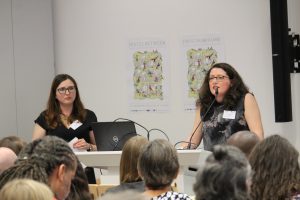 At the official beginning of the conference on Monday, the conveners Véronique Sina and Nina Heindl, as well as Manuela Günter (Vice-Rector for Gender Equality and Diversity of the University of Cologne), and Stephan Packard (President of the German Society for Comics Studies) welcomed all speakers and guests. They stressed that it is their great pleasure to open a conference that not only focuses entirely on gender, diversity, and identity in comics, but also presents a majority of female speakers as well as an all-female organizational team – a premiere for the German Society for Comics Studies.
Summer School Cologne “Virtual Children’s Media in a Global Perspective”
 Gabriele von Glasenapp, Felix Giesa, and Andre Kagelmann just announced the following Summer School (which, incidentaly, takes place at the same time as Patrick Noonan’s and Stephan Packard’s Cologne Summer School „Constructing Space, Building Place: Topographies of Comics and Visual Narration“ from August 27 to September 7)
Cologne Summer School: “Virtual Children’s Media in a Global Perspective | Globale virtuelle Kindermedienwelten” September 3.-16 2018, University of Cologne
The application for participation is open until March 31, 2018 (details below)
Research Perspective:
“As literary channels of communication are increasingly digitalised and virtualised, the study of children’s and young adult literatue should be recalibrated towards a more encompassing concept of children’s and young adult culture and media studies. So far, however, this has been limited to isolated endeavours often limited in scope, lacking a more systematic approach. Further complications arise from the fact that many relevant products on the German market are translated from other languages.
While this ›transnational flow‹ has well been recognised, its processual logics have yet to be charted in detail. Both aspects – a transnational flow and a transmedia expansion of narrative worlds – fundamentally alter the experiential worlds of children and young adults, including new practices of appropriation and consumption such as booktubes, online collections of solutions for computer games, or the integration of narrative computer games and social media. Existing academic work based on comparative transmedia and/or transnational paradigms provides first steps towards a more fundamental shift of perspective, paving the way for children’s and young adult culture and media studies.
These approaches form the bedrock of our summer school. Tracing the transdimensional quality of changing mediascapes, we propose a research design which combines perspectives from traditional philology, studies in children’s and young adult fiction and transmedia narratology as well as transnational and visual culture studies. The summer school thus aims to foster a deeper understanding of globalised virtual media worlds as targeted at children and young adults, and simultaneously, to sharpen the theoretical profile of studies in children’s and young adult literature research in an age of transnational media convergence. In this vein, it will bring together accomplished experts, excellent junior researchers and students.
Weiterlesen: Details zur Teilnahme
Report “Summer School: Transnational Graphic Narratives”
 University of Siegen, Germany. July 31st – August 5th 2017
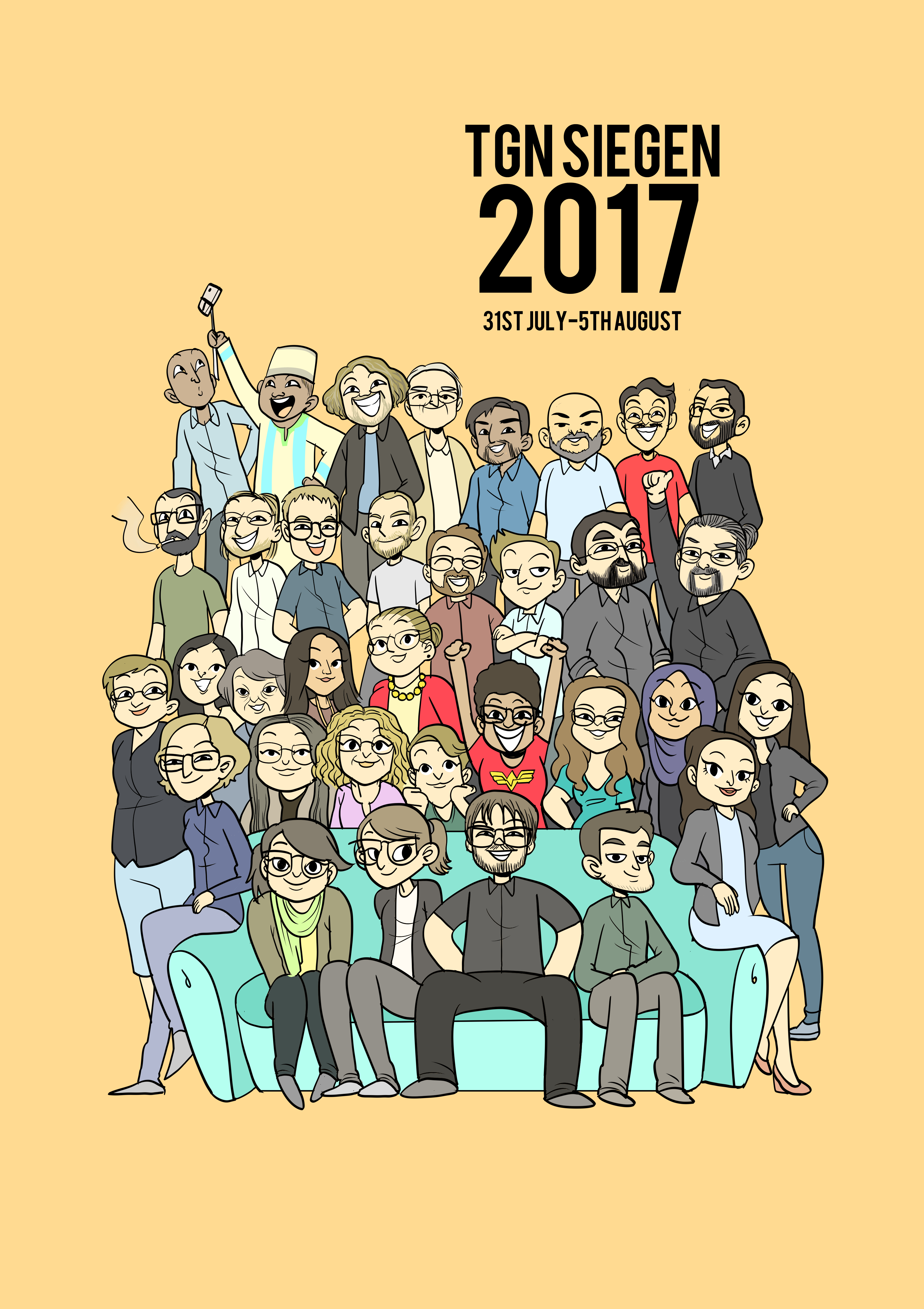
Contributed by Amadeo Gandolfo, Pablo Turnes, Laura Nallely Hernández Nieto and Lia Roxana Donadon
Illustration by Suraya Binti Md Nasir (artistic web profile: https://www.behance.net/
Introduction
The first Transnational Graphic Narratives Summer School (abbreviated TGN) was held at the University of Siegen, Campus Unteres Schloß, from July 31st to August 5th of 2017. The participants included the following scholars (in alphabetical order): José Alaniz (University of Washington, USA), Benoît Crucifix (Université de Liège, Belgium), Veronica Dean (University of Los Angeles, USA), Subir Dey (Indian Institute of Technology Guwahati, India), Harriet Earle (Sheffield Hallam University, England), Franca Feil (Goethe University Frankfurt, Germany), Moritz Fink (Academy for Civic Education Tutzing, Germany), Amadeo Gandolfo and Pablo Turnes (National University of Buenos Aires / CONICET, Argentina), Isabelle Guillaume (University of Bordeaux Montaigne, France), Olivia Hicks (University of Dundee, Scotland), Ganiyu A. Jimoh (University of Lagos, Nigeria), Kenan Koçak (Bilecik Şeyh Edebali University, Turkey), Sarah Lightman (University of Glasgow, Scotland), Suraya Md Nasir (Kyoto Seika University, Japan), Laura Nallely Hernández Nieto (National Autonomous University of Mexico), Barbara Postema (Concordia University, Canada), Johannes Schmid (University of Hamburg, Germany), Pfunzo Sidogi (Tshwane University of Technology, South Africa), Simon Turner (Sainsbury Institute for the Study of Japanese Arts and Culture, England), Jocelyn Wright (University of Texas, USA), Tobias Yu-Kiener (University of the Arts London, Great Britain), Giorgio Buzzi Rizzi (University of Bologna, Italy), Lia Roxana Donadon (University of Siegen, Germany).
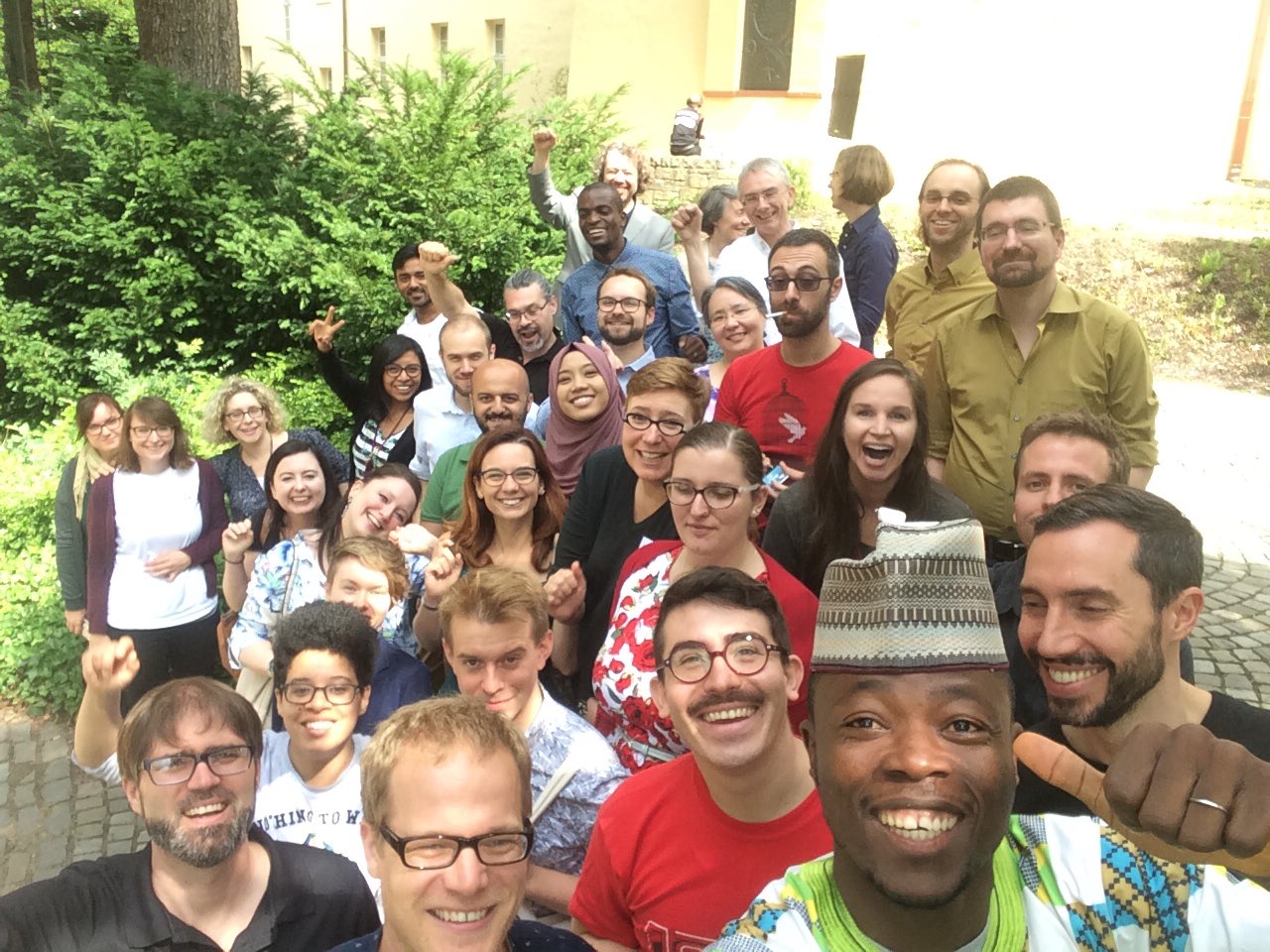
Group Shot by Jimoh Ganiyu
Organization
Prof. Dr. Daniel Stein and Dr. des. Lukas Etter (University of Siegen) were in charge of the organization of the TGN Summer School, with logistical support of student assistants Katja Dosztal and Yvonne Knop (University of Siegen). The Summer School was generously funded by the Volkswagen Foundation.
Invitation to subscribe: “ADVENTURES OF A NEW TELEMACHUS”
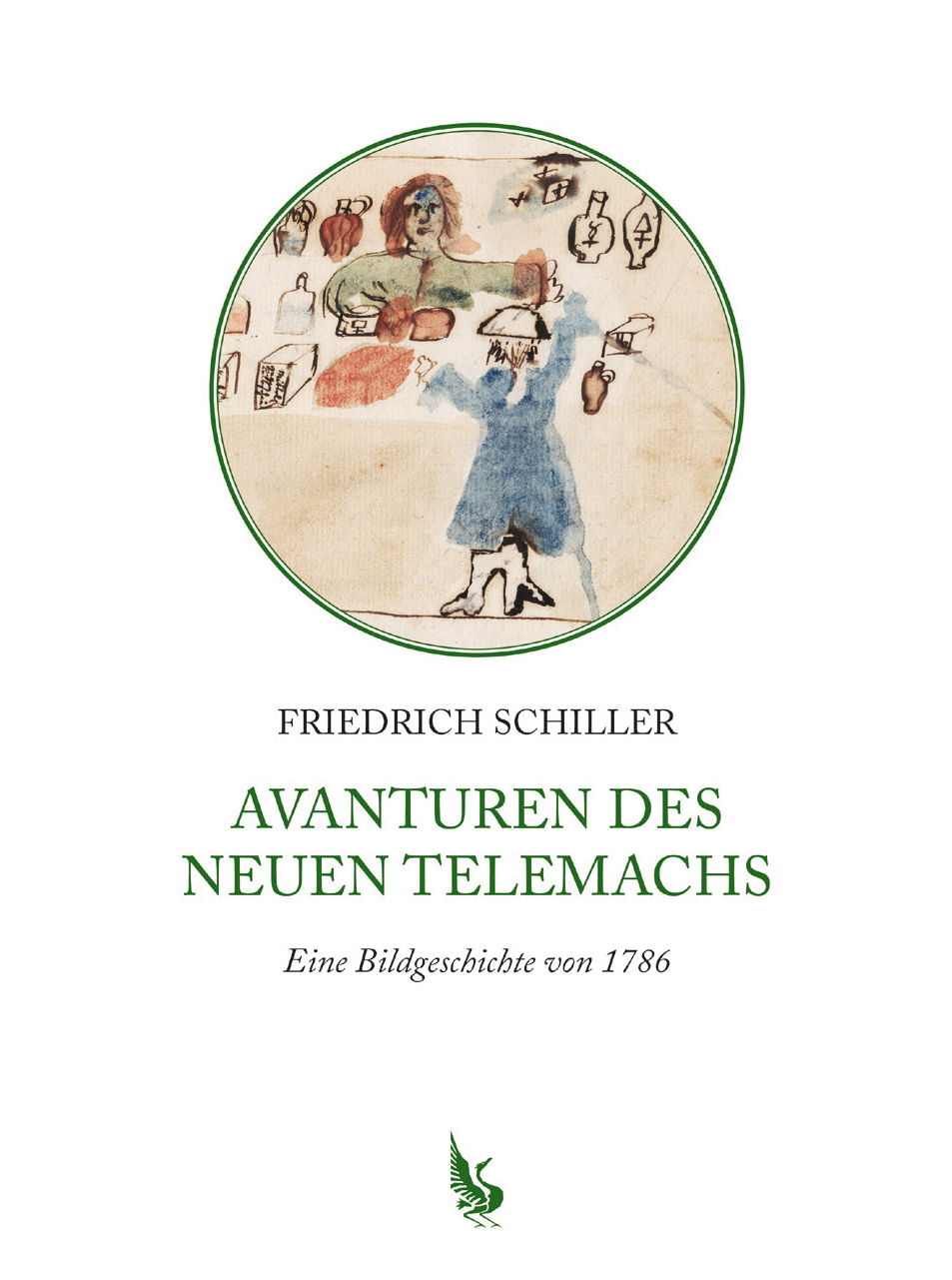 ADVENTURES OF A NEW TELEMACHUS:
A Picture Story from 1786
Edited and Introduced by Dietrich Grünewald; translated to English by Stephan Packard;
German and English Edition; hardcover, c. 100 Seitepages, with numerous colourful illustrations;
to appear in winter 2017/18;
ISBN 978-3-941030-46-6, € 25,00 (inkl. gesetzl. USt.);
€ 25,00 (incl. VAT) Subscription price available until 31 Oktober 2017: € 15,00 (incl. VAT).
In order to subscribe, please write to bestellen@christian-bachmann.de. Continue to Publisher’s page (German).
Publisher’s announcement:
“For his 30th birthday Christian Gottfried Körner, Friedrich Schiller’s friend and benefectator, received a picture story hand-drawn by the scandalous author of The Robbers. Initially intended as a private jest among close friends and later presumed lost, it has since been recovered an is finally presented in print complete with the accompanying manuscript by Ferdinand Huber for the first time. For ease of reading this edition complete with a transcript of the Huber’s manuscript in German and English. The historical context and aesthetics of Schiller’s picture story, in which Körner doubles Hercules, faces voracious crocodiles in Egypt, and even gets corned, is explained by Dietrich Grünewald in an extensive introductory essay.”
Flyer herunterladen (deutsch)
Download flyer (englisch)
Publisher’s page (German).
Conference Report “On the Aesthetics of the Made in Animation and Comic”
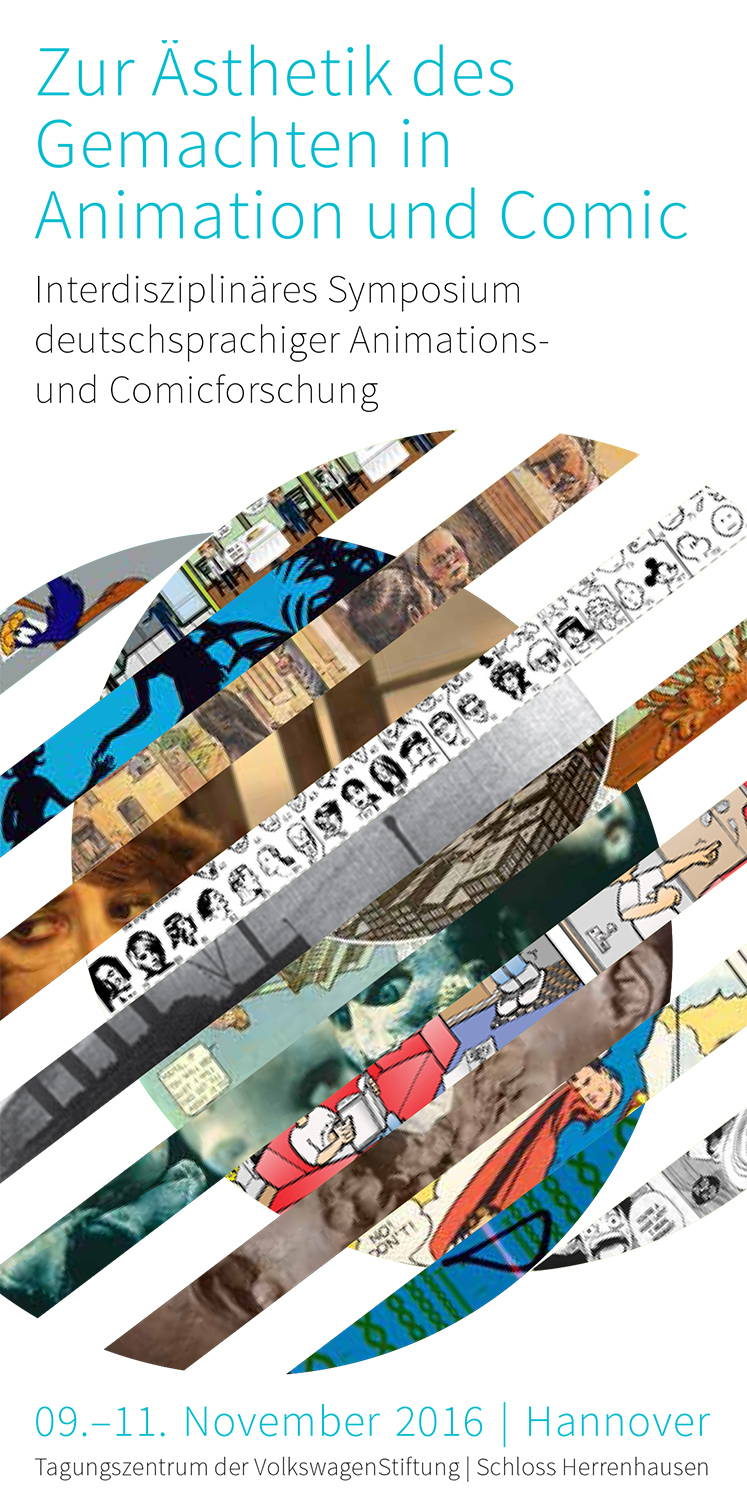 From November 9-11 2016, a co-operation of two commissions of the German Society for Media Studies (GfM) brought us a symposium on the aesthetics of artificiality in animation and comics, at Herrenhausen near Hannover: “On the Aesthetics of the Made in Animation and Comic”. The program was put together by Hans-Joachim Backe (Kopenhagen), Julia Eckel (Marburg/Bochum), Erwin Feyersinger (Tübingen), Véronique Sina (Köln), and Jan-Noël Thon (Tübingen).
Just now, two conference reports have been published in different journals:
On März 15 2017, Animation: An Interdisciplinary Journal (12.1) published English conference proceedings by Sebastian Bartosch (Hamburg):
Continue to the English report.
And on März 20 2017, ZfM – Zeitschrift für Medienwissenschaft released a German article on the conference by Vanessa Ossa (Tübingen):
Continue to the German report.
Masterclass with Lev Manovich

MASTERCLASS ON CULTURAL ANALYTICS WITH LEV MANOVICH
Date: 23 September 2015, 10am-5pm, University of Potsdam
To sign up for the workshop, please contact Jochen Laubrock at: laubrock@uni-potsdam.de. Participation is free but will be limited to 20 seats, so please register early.
Lev Manovich is Professor of Computer Science at The Graduate Center, City University of New York, and founder and director of the Software Studies Initiative. In 2014 he was included in The Verge’s list of the 50 “most interesting people building the future”. He is well known for the automated exploration, analysis, and visualization of big image data, as exemplified in the “One million manga pages” or “Selfiecity” projects. Manovich is the author of Software Takes Command (Bloomsbury, 2013), Black Box – White Cube (Merve, 2005), Soft Cinema (MIT Press, 2005), The Language of the New Media (MIT Press, 2001), Metamediji (Belgrade, 2001), Tekstura: Russian Essays on Visual Culture (Chicago University Press, 1993) as well as over 120 articles which have been published in 30 countries and reprinted over 450 times. He is also one of the editors of the Software Studies book series (MIT Press) and Quantitative Methods in the Humanities and Social Science (Springer).